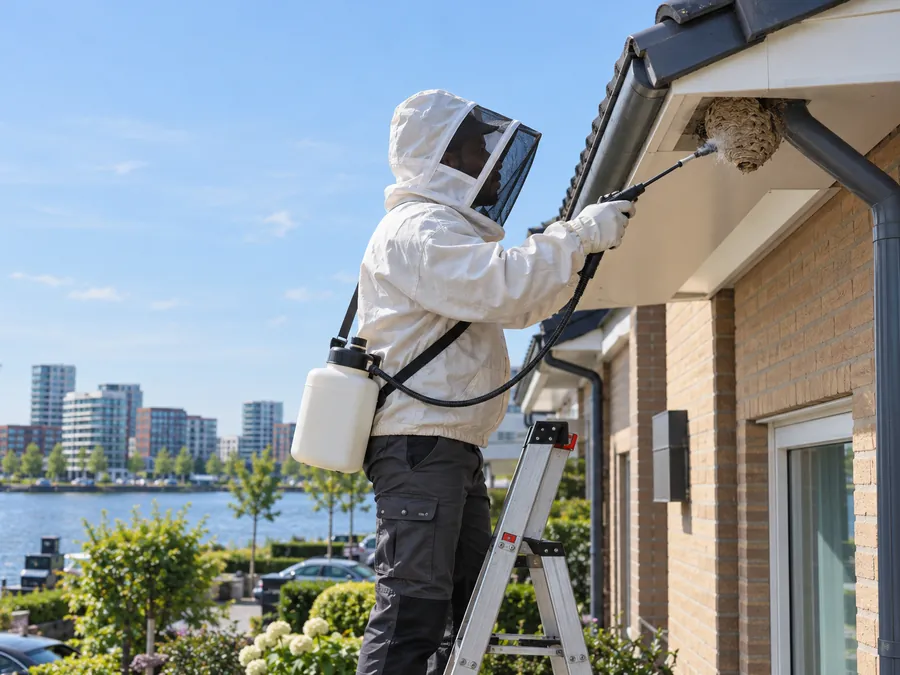

Wasp nest removal in Almere: finding the nest first
You rarely see the nest itself. What gives it away is a fixed flight path: wasps vanishing at the same spot again and again, then reappearing a moment later. That spot is the entrance. In Almere homes the nest is usually in one of these places:
- inside the cavity wall, entered through an open weep vent or a gap beside a window frame
- under the roof tiles or behind a wooden fascia board
- in the box of a roller shutter above a window
- in a shed, summerhouse or bird box
- underground, often in an old burrow beneath a hedge
Why tackling a nest yourself is risky
A can of spray from the DIY store will not reach a nest deep inside a cavity wall, but it will make the wasps aggressive. A colony defending its nest stings in numbers, and for anyone with an allergy that can be dangerous. Blocking the entrance hole backfires too: the wasps look for another way out, sometimes through a gap around a light fitting and into the house.
So leave the opening alone, keep nearby windows shut and keep children and pets away from the flight path. If other pests are bothering you as well, have a look at our pest control in Almere.
How we treat a wasp nest
During the inspection we follow the flight path to the entrance and confirm whether we are dealing with wasps, hornets or bees. We prefer to treat late in the day, when nearly all the workers are home and the product reaches the whole colony.
We apply a professional insecticide in or right next to the entrance; only certified pest controllers are allowed to use these products. The wasps carry it inside and the nest dies off. A nest inside a cavity does not need to be dug out afterwards, because wasps never reuse an old nest. We will, however, tell you which openings to seal or fit with a vent cover once the season is over.
Bee nest removal in Almere
Not every buzzing nest belongs to wasps. Honey bees are brown and hairy rather than bright yellow and black. In spring and early summer a swarm may hang like a large cluster in a tree or hedge, and it is usually surprisingly calm. Honey bees are not exterminated: we refer you to a beekeeper (imker), who can collect the swarm and give the bees a new hive. If a colony has already moved into a cavity wall or chimney, we look together at what is possible.
Bumblebees nest in the ground, under decking or in a bird box. Their nest stays small and dies off naturally after summer, so we leave it alone wherever we can. Not sure whether you have a bee nest or a wasp nest? Describe the insects to us on the phone.
Hornet nest removal in Almere
There are two hornets you may come across in the Netherlands. The European hornet is large and easy to recognise by its reddish-brown thorax and yellow abdomen. It nests in hollow trees, sheds, nest boxes or occasionally a cavity wall, and will fly towards outdoor lights after dark. Left undisturbed, it is fairly placid. The Asian hornet (Aziatische hoornaar) is slightly smaller and much darker, with yellow legs and an orange-yellow band on its abdomen. Its large nest is usually built high up in a tree and often only spotted once the leaves drop.
Never try to remove a hornet nest yourself. Sightings of an Asian hornet or its nest can be reported on waarneming.nl. Removal is a job for a professional with the right equipment, and we will discuss the best approach for your situation.
Preventing next year's nest
Every wasp nest starts in spring with a single queen looking for a dry, sheltered corner. A large wasp inspecting your walls or shed in April or May is exactly such a queen. Seal openings outside the wasp season, once there is no active nest.
- Fit weep vent covers so the cavity can still breathe while insects stay out
- Have loose roof tiles and gaps behind the fascia repaired
- Check the shed and summerhouse in spring for a small nest in the making
- In late summer, pick up fallen fruit and cover sweet drinks on the patio
A tidy shed helps against rodents too. If you find large droppings or gnaw marks there, read more about rat control.